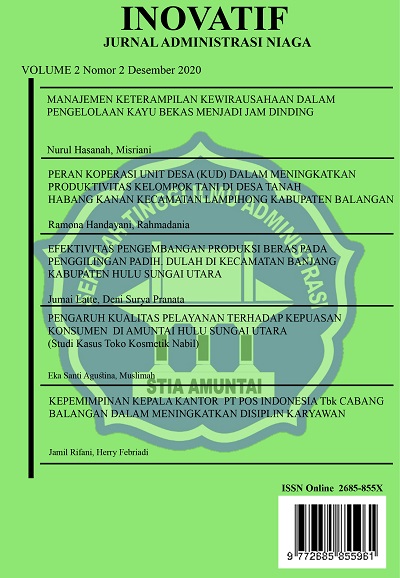
PENGARUH KUALITAS PELAYANAN TERHADAP KEPUASAN KONSUMEN DI AMUNTAI HULU SUNGAI UTAR (STUDI KASUS TOKO KOSMETIK NABIL)
DOI:
https://doi.org/10.36658/ijan.2.2.77Keywords:
pelayanan, kepuasan, konsumenAbstract
This study aims to determine the effect of service quality on customer satisfaction in Amuntai Hulu Sungai Utara (Case study of Nabil Cosmetics Shop). The analysis technique used is descriptive with a quantitative approach. Quantitative data in this study is in the form of ordinal from respondents' answers to the questions posed in the questionnaire. The t-statistic value of the path of the influence of the Responvenism variable on customer satisfaction in Amuntai Hulu Sungai Utara (Case study of Nabil Cosmetics Shop). is 2.562 which is greater than the normal distribution t-table of 1.96, meaning that there is a significant influence between the variable Responvenism and customer satisfaction, customer satisfaction in Amuntai Hulu Sungai Utara (Case study of Nabil Cosmetics Shop). responsive is the ability of a company that is carried out directly by employees to provide services quickly and responsively. The results showed that there was a positive and significant influence between the responveness factors on consumer satisfaction in Amuntai Hulu Sungai Utara (Case study of Nabil Cosmetics Shop). From the SPSS estimation results, another conclusion appears that the satisfaction model studied is actually only able to explain the phenomenon of consumer satisfaction in Amuntai Hulu Sungai Utara (Case study of Nabil Cosmetics Shop) of 68.9%. While the remaining 31.1% is explained by other variables which are not included in the model and error.
References
http://repo.iain-tulungagung.ac.id/3803/3/BAB%20III%20REVISI.pdf 26 September 2020
https://penalaran-unm.org/deskriptif-kuantitatif/29september2020 (http://eprints.ums.ac.id/50125/3/BAB%20I.pdf di akses 10 April 2020)
(http://repository.upi.edu/1408/4/S_IND_0906911_Chapter1.pdf di akses 12 April 2020)
(https://eprints.uny.ac.id/7732/3/BAB%202-06408144012.pdf di akses 19 April 2020)
(https://repository.usd.ac.id/12796/2/132214100_full.pdf di akses 15 April 2020)
(https://media.neliti.com/media/publications/99180-ID-pengaruh-bauran-pemasaran-terhadap-keput.pdf di akses 19 April 2020)
(http://eprints.walisongo.ac.id/1808/4/092411107-Bab3.pdf 02 Mei 2020)
(http://digilib.uinsby.ac.id/1734/9/Bab%203.pdf di akses 05 Mei 2020)
(http://eprints.undip.ac.id/40779/3/BAB_III.pdf di akses 09 Mei 2020)
http://etheses.uin-malang.ac.id/729/6/10510122%20Bab%202.pdf
september 2020
http://etheses.uin-malang.ac.id/810/8/10410021%20Bab%203.pdf 22 sep 2020
http://etheses.uin-malang.ac.id/1552/6/11410152_Bab_2.pdf
http://repository.unpas.ac.id/32892/6/BAB%20III.pdf
http://eprints.ums.ac.id/40656/5/04.%20BAB%20I.pdf 26 sep 2020
Prof.Dr.Sugiyono. (2010). ”Metode Penelitian Kuantitatif, Kualitatif dan R&D”,Catatan ke-10
Nana Koniman, 2013”Penerapan Metode Diskusi Pada Pembelajaran IPS Materi Perkembangan Teknologi Untuk Meningkatkan Hasil Belajar Siswa Universitas Pendidikan Indonesia |repository.upi.edu|perpustakaan.upi.edu